Rooted in Nature: A Bio-Inspired Strategy Using Bacteria to Enhance Plant Fitness
A biologist takes inspiration from fungus-growing ants in his research with microbes that grow on roots in soil.
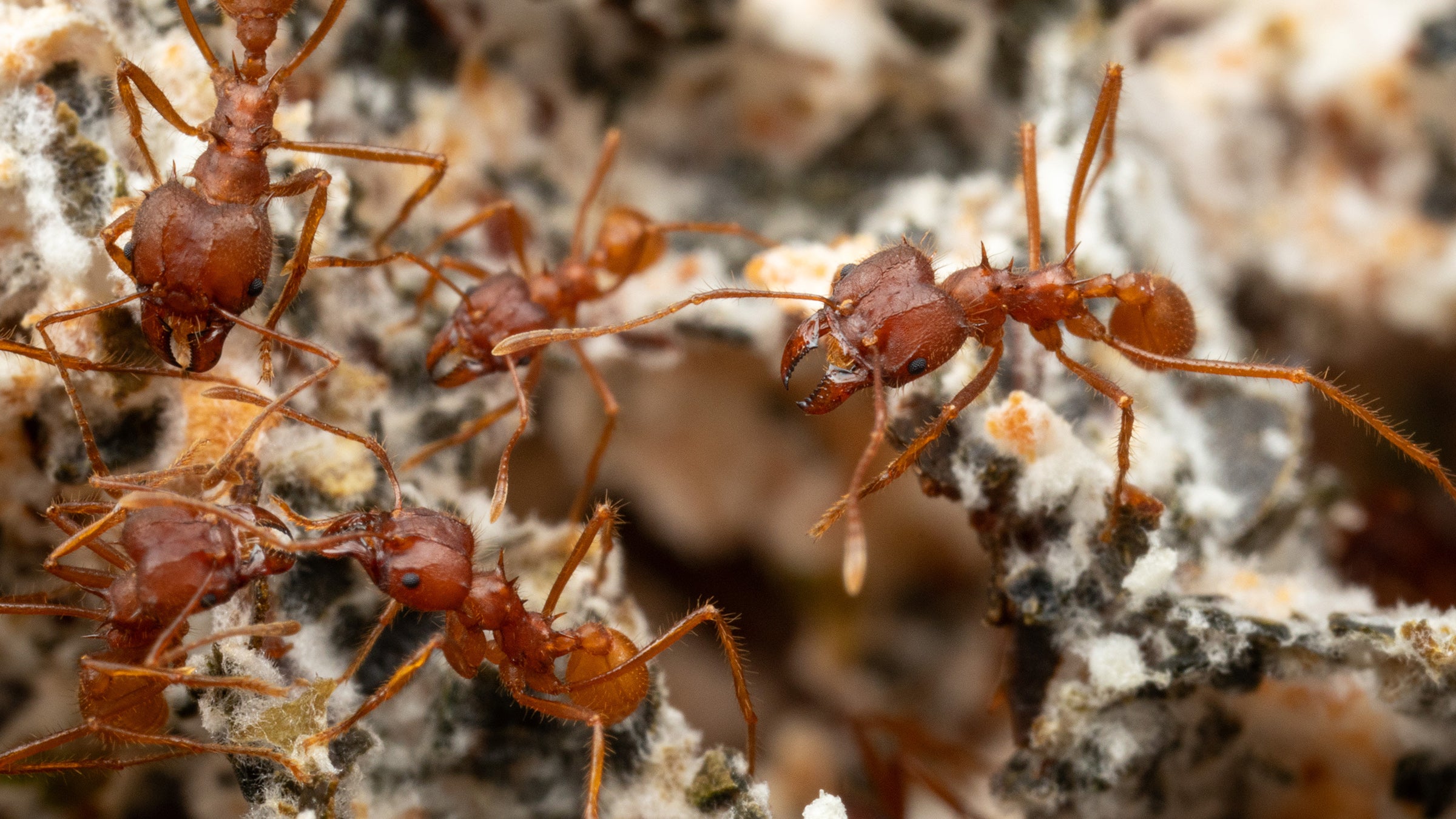
Leafcutter ants, seen here on fungi, inspired Ulrich Mueller’s research on microbiome selection. Credit: Alexander Wild.
Humans began growing crops around 12,000 years ago, but leafcutter ants have been farming fungi long before that. When these ants transplant white, spongy fungi into a new garden, they simultaneously propagate the microbes that confer benefits to the cultivated fungi as well, enhancing the fungus’ fitness.
“The agriculture of these insects is so much smarter because they’ve done it for 66 million years,” said Ulrich Mueller, professor of integrative biology at The University of Texas at Austin. “Evolution figured out a lot of things that we’re just beginning to figure out.”
Mueller initially researched fungus-growing ants and was a postdoctoral fellow at the Smithsonian Tropical Research Institute in 1996 when he realized that the ants may be indirectly screening the fungi for beneficial microbiomes. This early insight allowed him to pioneer research in microbiome breeding with potential applications to human agriculture.
Recently, Mueller and his colleagues in integrative biology published the latest set of results in this area, which demonstrated that microbiome breeding could be used to help confer to plants tolerance towards high salt concentration in soil. Their efforts decreased sodium concentration in leaves of plants they intervened with by 50%, leading to healthier plants more likely to survive in high-stress conditions.
Microbiome breeding involves changing an organism’s microbiome with human intervention in order to maximize beneficial bacteria. To achieve this, Mueller transplants bacteria from one plant’s roots to a new generation’s seeds.
With a gift of 50 seeds from Thomas Juenger, also a professor of integrative biology at UT, Mueller began conducting experiments on microbiome breeding of a grass in the summer of 2010.
The first few years were filled with trial and error, as Mueller explored the best conditions for growing plants in greenhouses and conducted pilot experiments.
“For the first three years, I did about four or five experiments, and I learned mostly how not to do things,” he said. “I think that’s typical for science, when you try something new, and nobody’s worked out a technique.”
In 2015, Mueller established methods that scientists are now using worldwide to study microbiome breeding, inspired by the ants that have long fascinated him.
When humans make choices on what plant cuttings to propagate, their decisions are based on the plants with the healthiest aboveground structures, like those with abundant seeds. Yet, when moving the plants, humans leave behind beneficial microbes that may allow the plant to have increased disease resistance or resist environmental stressors.
“The ants never leave anything behind that is associated with their crop,” Mueller said. “They probably don't see and smell the microbes. They just look at how well the crop is growing, and that tells them indirectly that there’s beneficial microbial elements associated with that.”
Mueller takes a similar approach with his work as he analyzes the performance of plants to understand which ones may contain microbes that enhance plant fitness.
“When a plant grows really well, I can infer that there are beneficial microbes associated with it that I should harvest and move from one plant to the next,” Mueller said. “The microbes are taken from a root and are moved onto the seeds of the next generation.”
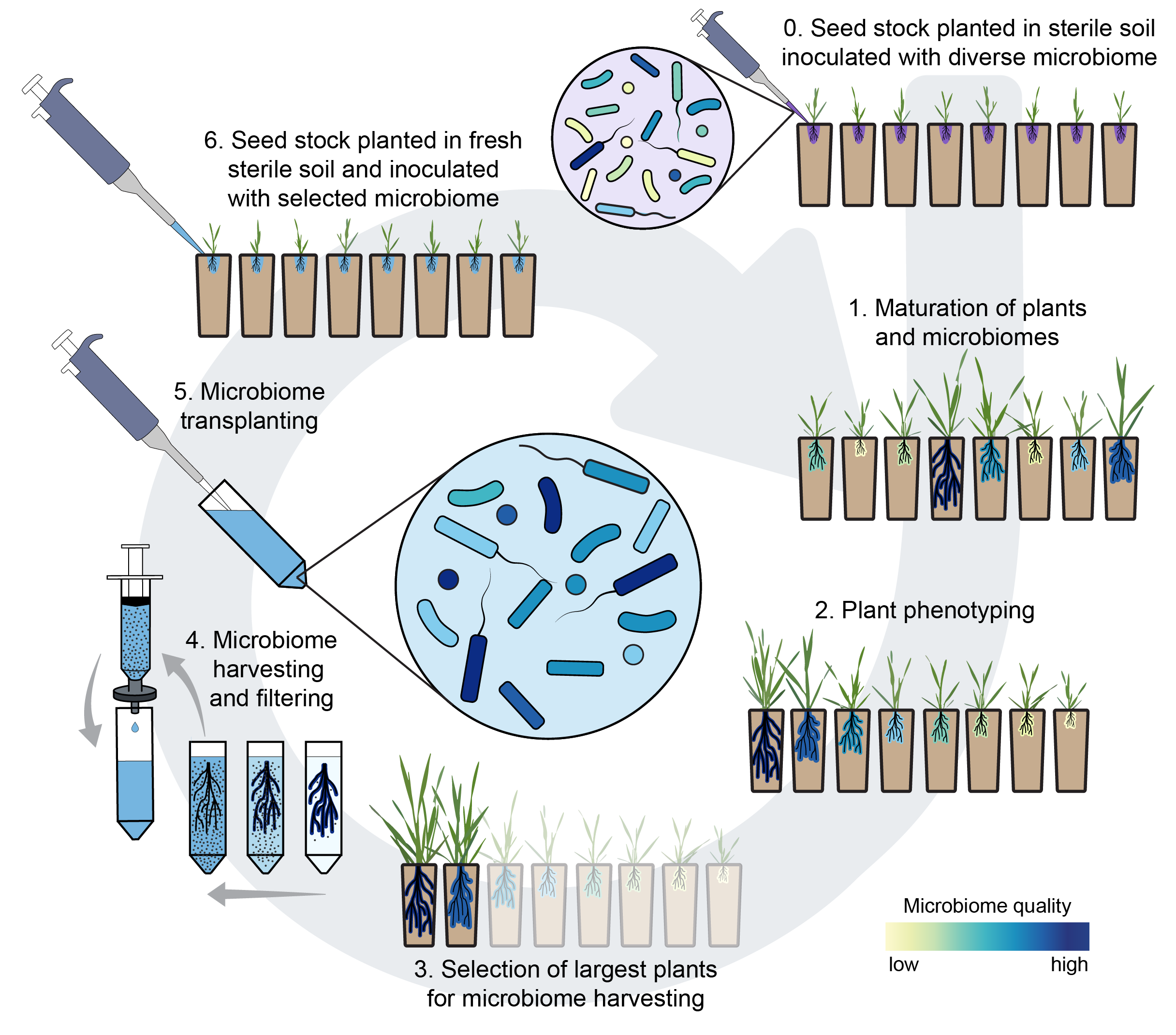
Microbiome selection involves introducing root-associated microbes to seedlings, allowing the plants to grow, and harvesting the microbiomes of the largest plants, which are then introduced to new seedlings. Credit: Ulrich Mueller.
While Mueller’s research has traditionally centered on understanding the phenotypic effects of microbiome selection on plants, it was a suggestion from Caio Guilherme Pereira, a research associate in the Juenger Lab, that led to the recent investigation of mechanisms underlying sodium and aluminum stress in plants.
“Salt and drought are the big stresses in human agriculture,” Mueller said, explaining that salt stress is particularly relevant due to climate change.
As farmers water their fields, salt from the water accumulates in soil. Unless the salt gets washed out by rain, the salt concentration in the ground increases, hurting plant growth. As the climate becomes warmer due to climate change, plants require more irrigation, thus increasing the salt concentration of soil.
While the environmental stability required for microbiome breeding limits its large-scale agricultural applications, Mueller explained that scientists can use this technique to find promising microbes. In his team’s recent paper, the researchers identified three microbes that are most likely to be the ones that confer salt tolerance.
“The next thing is to isolate those microbes and test those with plants and see whether a single microbe that you inoculate onto a plant can confer that tolerance,” Mueller said.
Earlier this century, when Mueller began research in the field, microbiome selection was still a nascent field. Over the past 15 years, Mueller has seen microbiome selection burgeoning, as new theories have sprouted about which microbes provide benefits and the mechanisms through which they do so.
In the next decade, Mueller believes the study of microbiome breeding will continue to grow, blurring the line between evolution and ecology.
“Since 2015, when we published the first review paper, a lot of people have moved into this research area,” Mueller said. “It's really great to see that out of nothing, this new research area came about.”